Welcome to the Water Innovation Hub newsletter: quarterly insights on the technologies, investments, and perspectives shaping the future of water. Sign up for the newsletter to stay up to date.
If you're new here, we are ClimateHaven's Water Innovation Hub. In partnership with the Regional Water Authority of New Haven and Xylem, we accelerate the development and deployment of novel water technologies, through pilots, startup incubation, and strategic partnerships. This newsletter offers a window into our work and real opportunities for you to engage.
Before we dive in, two quick asks: Join us for our quarterly Green Drinks on February 26 at ClimateHaven HQ. This edition will feature artists showcasing work inspired by our planet. And if you find this newsletter valuable, we would appreciate you forwarding it to a water curious friend.
Without further ado, let’s turn on the tap.
Water moves through a cycle, but it also moves through systems. At every step, a massive amount of infrastructure underpins the everyday act of turning on a tap. Let’s break that down.
In the US, 74% of water is sourced from surface waters like lakes, rivers, and streams, with the remainder from groundwater. This water is delivered by more than 148,00 public water systems, the majority of them small, under-resourced, and operating far from public view. Utilities, quasi-public authorities, and municipalities manage these systems: they source water, treat it to regulatory standards, store it, and distribute it through 2 million miles of underground transmission and distribution pipes to homes, businesses, and industry.
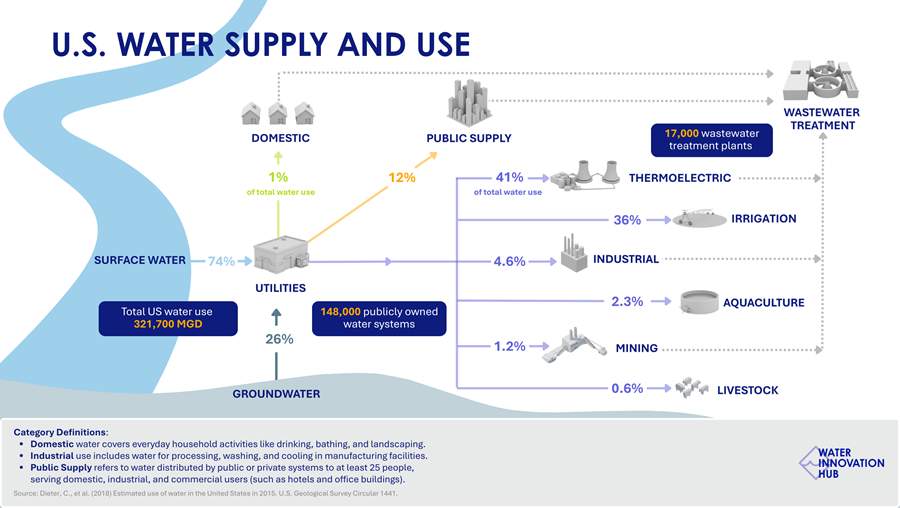
Once used in homes, businesses and industries, and if not reused locally, the wastewater travels through another vast network of 1.87 million miles of pipes to more than 17,000 treatment plants. There, it is treated and discharged back into rivers, lakes, and coastal waters, back to the broader water cycle.
Stormwater management adds another layer of complexity. These systems vary widely by jurisdiction, with their own networks of conveyance infrastructure, and are often managed by municipalities or public works departments.
Beneath the surface, much of this infrastructure is rapidly aging, in need of trillions of dollars of investment, and managed by small utilities who do not have the capacity to invest in these upgrades. That raises a fundamental question: who pays to keep this system working?
When utilities are asked how they plan to fund major upgrades, the answer is usually rate increases. At the same time, we expect water to remain affordable and accessible to everyone. That tension is not theoretical; it shows up in budget meetings, capital plans, and delayed investments across the country.
Water use has recently become more mainstream in public discourse, driven in part by concerns that AI and data centers are “using too much water”. While much of this conversation is misguided (Xylem and GWI’s recent report explores this in depth), it surfaces a real issue. The challenge is not that emerging industries suddenly change total water availability, but that concentrated new demand can strain treatment capacity, reliability, and infrastructure that is already under stress.
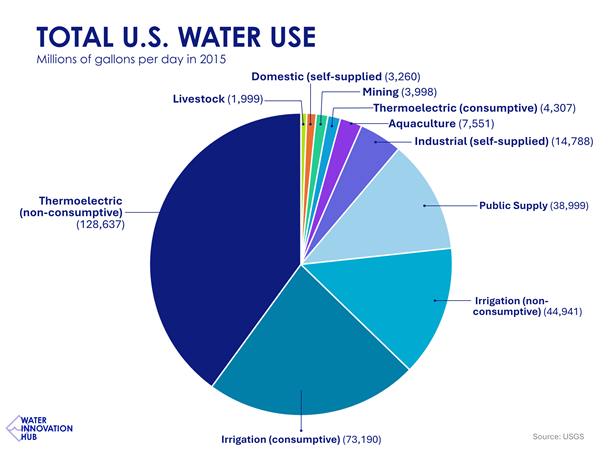
Energy, agriculture, and livestock dominate total demand. The country consumes roughly 322 billion gallons of freshwater every day. At the household level, the average American lifestyle accounts for about 420 gallons per person per day.
Unlike energy, where new demand can be met with dedicated generation assets, water has no clean analog to “build more supply.” Industrial and residential users rely on the same treatment and distribution systems, every new source of demand tightens constraints for everyone else.
Water scarcity, in practice, is therefore a systems problem: capacity, quality, and resilience are shared, and strains on the system impact all.
When industrial users help fund more advanced treatment and monitoring systems, the benefits extend beyond any single customer. Communities drawing from the same source waters gain more resilient, higher-performing infrastructure. Examples in states like Oregon, Washington, and Arizona show how new industrial demand can help unlock essential upgrades that otherwise would not pencil out.
In this context, increased demand can play a constructive role. New demand can accelerate upgrades, improve utility creditworthiness, de-risk capital investments, and create more consistent revenue streams. Water infrastructure benefits from economies of scale, yet remains highly regional. Improvements need to occur across entire systems, not in isolated pockets.
This is the work we are focused on through the Water Innovation Hub. We see collaboration, enabled by innovation, as essential to managing interwoven resources like water, energy, and climate. Utilities cannot shoulder the scale of investment required to modernize infrastructure on their own. Because these challenges are shared, there is real opportunity to align incentives and accelerate innovation.
New technologies make it possible to modernize infrastructure in waves, enabling practical, lower-risk upgrades that strengthen system resilience as climate pressures and industrial demand continue to grow. Be it through robotic inspection of aging pipe infrastructure, real-time monitoring of water quality, or non-invasive technologies to detect lead service lines. Our goal is to work closely with innovators and entrepreneurs who are solving real, system-level challenges and to accelerate their path to market in partnership with utilities, corporates and water users.
In the seven months since launch, the momentum around the Hub has been encouraging. This year, we are initiating pilots with our founding partner, the Regional Water Authority, as changing climate conditions create new challenges for surface water quality and harmful algal blooms. Real-time detection of these blooms can significantly reduce treatment costs while improving operational decision-making. Our innovation challenge winner, Nucleic Sensing Systems will be piloting their environmental DNA biosensor technology this summer.
If you are interested in learning more or supporting this pilot, reach out to us.
Looking ahead to 2026, here are a few key initiatives we’re planning:
Investor and startup interest in water is accelerating, driven by rising industrial demand, growing recognition of historic underinvestment in water infrastructure, and increasing urgency for new solutions.
Our MBA Fellow, Ioana Solomon, recently spoke with investors Peter Yolles and Tom Ferguson about where they see the most compelling opportunities emerging across the sector. We also enjoyed Tom’s presentation at IDWS, where he spoke about water investment entering a new era and moving into a stage of sustained growth.
This is the first edition of our quarterly Water Innovation Hub newsletter, we are just getting started and would welcome your perspective. Please feel free to email us with ideas on how we can better support this ecosystem.
Thanks for reading, and helping keep innovation flowing.
Aish Kuruttukulam
Director


