

Industrial wastewater is often grouped into a single category. In reality, water coming out of an oil well has very little in common with geothermal brine, acid mine drainage, or wastewater from a food processing plant. The chemistry, treatment requirements, regulations, and economics vary enormously from one industry to another.
With less than a week left to apply for the 2026 Xylem Innovation Challenge, we are looking at the wastewater dynamics across three industries where water is central to operations: oil and gas, mining, and geothermal.
What's in the water?
Every treatment decision starts with understanding the water itself: what contaminants are present, at what concentration levels, and how the chemistry changes over time.
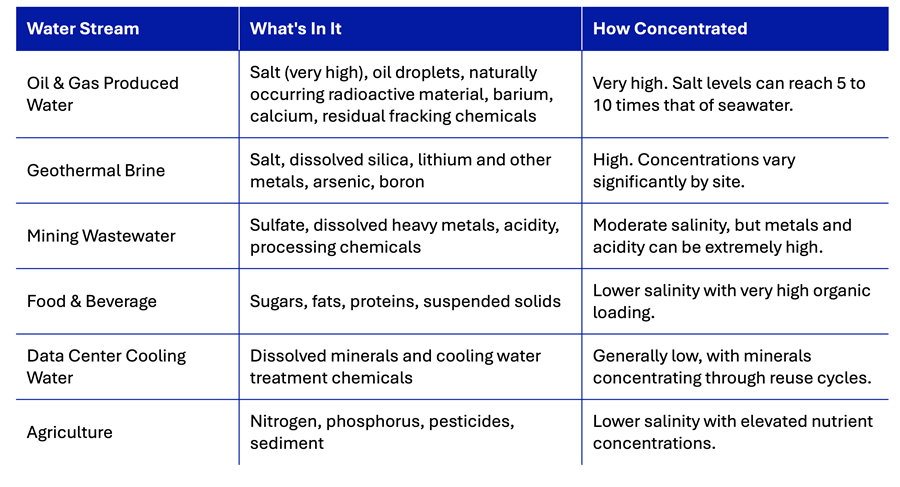
A technology that performs well in one industry may have little value in another. Biological treatment is highly effective for food and beverage wastewater because microbes consume organic matter. Those same microbes have little role in geothermal brines or acid mine drainage, where salts, silica, and metals dominate. Reverse osmosis can produce exceptionally clean water, but saline-heavy produced water creates higher pressure, fouling, and scaling challenges, often pushing operators toward thermal or hybrid desalination systems.
How much water are we talking?
We are focusing on oil and gas, geothermal, and mining because each industry moves enormous volumes of water, in the billions of gallons per day, and depend on it for day-to-day operations.
Oil & Gas produces the largest wastewater stream of the three. Every barrel of oil typically brings three to five barrels of produced water to the surface, and in parts of the Permian Basin the ratio can exceed ten to one. Today, the basin generates more than 20 million barrels of produced water every day. Companies such as Select Water are building large-scale recycling infrastructure around these streams, while LibertyStream and Element3 are using that infrastructure to recover lithium before the water is reused or disposed of.
Geothermal plants also circulate significant volumes of brine. A typical 20 MW facility can move close to 10 million gallons of underground brine each day, with most of it reinjected to maintain reservoir pressure. Increasingly, these brines are also being viewed as a source of critical minerals. BHE Renewables is partnering with TerraLithium to recover battery-grade lithium before the brine is returned underground.
Mining water volumes vary much more widely, but often create the longest-lasting environmental challenge. Acid mine drainage can continue forming for decades after a mine closes, requiring ongoing treatment.
Across all three industries, regulation shapes how much water must be treated and to what standard. Reinjection remains the lowest-cost option for much of this water, but induced seismicity, rising disposal costs, aging wells, and tighter limits on disposal capacity are putting that model under pressure. As treatment becomes more necessary, the economics of reuse and resource recovery become more compelling.
Building the treatment train
Treatment is rarely a single process. Instead, operators combine different technologies depending on the chemistry of the water and the quality required at the end of the process.
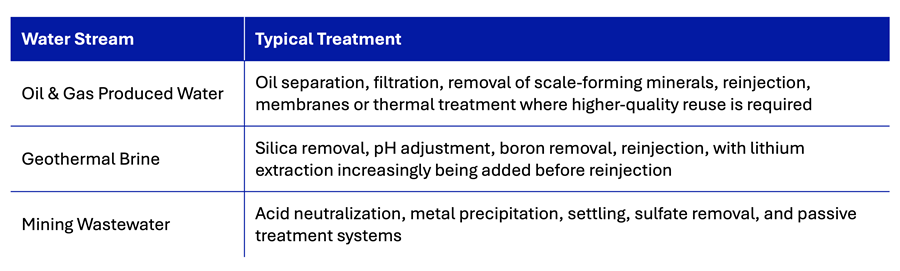
Produced water typically undergoes oil separation before membranes remove dissolved salts. Mining wastewater often requires chemical neutralization before metals can be settled out. Geothermal brines are treated to control silica and other minerals before reinjection or mineral recovery.
In practice, treatment is built by combining multiple technologies into a single process. Much of today's innovation is not replacing these approaches, but making them more efficient, more selective, and less energy intensive while improving how they work together.
That systems perspective is where companies like Xylem play an important role. Over decades, they have developed expertise across treatment technologies, pumping, monitoring, controls, and system integration. For emerging technologies, success often depends as much on fitting into an existing treatment train as on improving a single step within it.
Looking ahead: 2026 Xylem Innovation Challenge
We’re still considering startups for the Xylem Innovation Challenge, where two startups will have the opportunity to pilot with Xylem in two specific themes: critical minerals recovery and energy recovery in real-world environments. Engaging in the challenge offers startups a structured pathway to engage with the world leader in water to validate the technical potential of your solution, gain commercial traction and potentially pilot. We have a week remaining to be considered. Apply now!
Get Involved
- Become a reviewer: Are you a water expert or industry practitioner interested in emerging technologies? Join the Xylem Innovation Challenge review committee to evaluate startups, provide feedback, and help identify the strongest companies for the program. Fill out this form here.
- Join us at NY Climate Week: We will be announcing our six finalists of the Xylem Innovation Challenge and hearing from industry leaders on critical minerals at WaterTech Futures on September 22. Join us!
Five things we are learning about water:
- CRH's Oldcastle Infrastructure closed its $700M acquisition of Axius Water from KKR and XPV. A building-materials giant buying a nutrient-removal platform — signals that advanced treatment is now becoming core infrastructure.
- Western Midstream announced the startup of its second Permian produced-water pilot with Chevron, ConocoPhillips, Devon and ExxonMobil, treating 2,000 barrels of oilfield wastewater a day into 1,000 barrels of reclaimed freshwater, ten times the first pilot.
- Nvidia is advancing liquid cooling for AI factories, cutting data-center water use sharply and shifting the debate around AI-water use.
- SewerAI closed a growth-equity investment led by JMI Equity to scale its AI platform for sewer inspection and rehab planning.
- Wichita approved nearly $10 million to build a small-scale purification plant that turns wastewater into drinking water, aiming to become one of the first US cities to route treated sewage directly into the tap.
Thanks for reading, and for helping keep innovation flowing.
Aish Kuruttukulam
Director of ClimateHaven